The Peloponnese is the Greece trip I would choose when the islands feel too crowded, too expensive or too choreographed. You still get clear water, long lunches, ancient ruins and whitewashed villages, but the rhythm is more road trip than ferry schedule.
For summer 2026, it also fits a bigger travel shift: people want Greece, but they want space. The Peloponnese gives you that if you build the route carefully and resist the urge to see the entire peninsula in one week.
Toma is useful here because the app builds AI-powered personalized itineraries around your pace, budget and travel style, then turns the trip into a Travel Wrapped at the end. On a route with beaches, ruins, mountain towns and driving days, that kind of structure matters.
Why the Peloponnese works so well in summer
The Peloponnese has the ingredients people usually chase in the Greek islands, but with fewer logistics. You can land in Athens, rent a car and reach your first stop without dealing with ferry delays or island-hopping math.
Summer is hot, especially around archaeological sites, so the trick is not to plan like a museum marathon. Put ruins early in the morning, beaches in the afternoon and villages at sunset. That simple pattern makes the whole route feel better.
The region also rewards travelers who like variety. One day can be ancient Mycenae and a seafood dinner in Nafplio. The next can be a swim near Kardamyli, a mountain village, then a slow taverna meal under plane trees.
The best route for a first trip
For a first Peloponnese road trip, I would keep the loop tight and beautiful rather than ambitious. Seven to nine days is ideal. Five days works if you focus on one side. Two weeks lets you go deeper into Mani, Monemvasia and the western coast.
A smart first route looks like this:
- Nights 1 and 2: Nafplio for the old town, fortress views and nearby ancient sites
- Night 3: Mystras or Sparta for Byzantine ruins and mountain scenery
- Nights 4 and 5: Mani or Kardamyli for stone villages, swimming and coastal drives
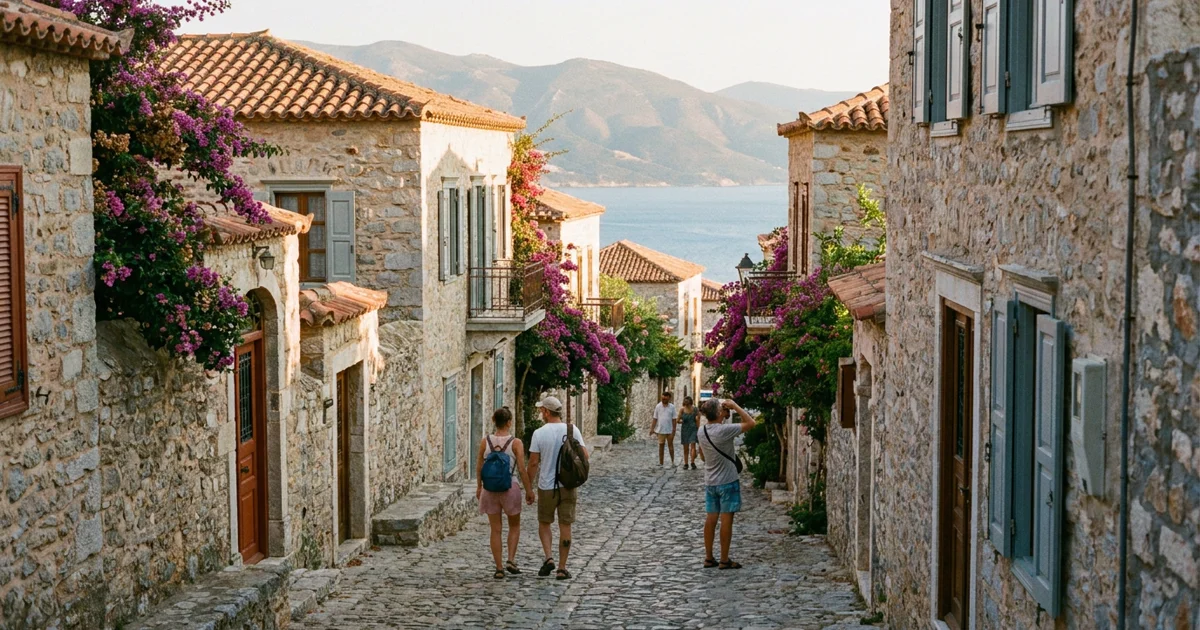
- Night 6: Monemvasia for the fortified old town
- Night 7: Return toward Athens, with a slow stop if your flight timing allows
This route gives you the point of the Peloponnese without turning every day into a packing exercise.
Start in Nafplio
Nafplio is the easiest first base because it feels instantly rewarding. The old town is walkable, the waterfront is calm in the evening and the Palamidi Fortress gives you the kind of view that makes the drive feel worth it.
It is also practical. From Nafplio, you can visit Mycenae and Epidaurus without changing hotels. Go early, bring water and do not plan both at the hottest part of the day. Ancient stones in July are not romantic at 2 p.m.
Spend your evenings simple: a swim if you have time, a long dinner, a walk through the old town and maybe one drink by the harbor. This is where the trip starts to slow down.
Add ancient sites without overloading the route
The Peloponnese is packed with history, but the mistake is trying to see every major site because they all sound important. Pick a few and give them space.
Mycenae is the classic stop for Bronze Age history and the Lion Gate. Epidaurus is worth it for the theater alone. Mystras, near Sparta, feels different because it is a hillside Byzantine city with churches, stone paths and wide valley views.
If you love ruins, add Ancient Messene or Olympia. If you are more beach-driven, keep the historical stops tighter and protect your afternoons. A good road trip is not the same as a complete syllabus.
This is a good moment to use Toma mid-trip. The app can adjust your personalized itinerary when you realize you want more beaches and fewer ruins, and it still keeps the route coherent instead of letting the day collapse into random pins.
Drive into Mani for stone villages and water
Mani is where the Peloponnese becomes dramatic. The landscape gets drier, the stone towers appear and the roads start dropping toward coves that look better in person than they do on a map.
Kardamyli is a gentle base if you want beauty without feeling remote. Areopoli has more stone-village character and puts you deeper into Mani. Limeni is gorgeous for a swim and a meal, but it can feel polished and busy in peak summer.
The best days here are not complicated. Swim early, drive a scenic stretch, stop in a village, eat slowly and watch the light change on the stone houses. If you try to rush Mani, you miss the reason to go.
Make Monemvasia your cinematic stop
Monemvasia is the most obvious wow moment on this route. The old town sits behind stone walls on a massive rock connected to the mainland by a causeway. Yes, it is popular. It is still worth it.
Stay overnight if you can. Day trippers leave, the alleys quiet down and the place becomes much more atmospheric. Bring light luggage if you sleep inside the old town because rolling a giant suitcase over stone lanes is a poor life choice.
Use Monemvasia as a slow finale, not a rushed detour. Walk, climb if the heat allows, have dinner inside the walls and let the setting do the work.
How to handle the summer heat
The Peloponnese in summer is not a destination for heroic midday sightseeing. Build the day around heat management and the trip gets dramatically better.
Plan archaeological sites before 10 a.m. or late in the day when possible. Keep the middle of the day for lunch, swimming, driving with air conditioning or a shaded village break. Book hotels with parking or easy access because dragging bags uphill in August is the opposite of vacation.
Also leave room for imperfect timing. Greek summer travel gets easier when you stop pretending every day needs a perfect sequence.
Where to spend and where to save
Spend on the rental car, air conditioning and location. A slightly better base can save hours of driving and make evenings easier. Spend on a few excellent meals too, especially in coastal towns where grilled fish, salads and local olive oil can become the memory of the day.
Save by avoiding one-night stays whenever possible. Every hotel change costs time. Save by choosing apartments or small guesthouses outside the most polished corners. Save by mixing famous beaches with quiet local swimming spots that do not require a full production.
The Peloponnese is not automatically cheap, but it gives you more control than many island trips. You can make it comfortable without making it flashy.
A realistic 7-day Peloponnese itinerary
Day 1: land in Athens, pick up the car and drive to Nafplio. Keep the evening easy.
Day 2: visit Mycenae early, return to Nafplio, climb Palamidi later if the heat is manageable.
Day 3: stop at Epidaurus or drive toward Mystras, depending on your history appetite.
Day 4: explore Mystras in the morning, then continue toward Mani.
Day 5: base in Kardamyli, Areopoli or nearby. Swim, drive, eat and slow down.
Day 6: continue to Monemvasia and sleep inside or near the old town.
Day 7: enjoy Monemvasia early, then return toward Athens or add one buffer night.
That route is not the entire Peloponnese. That is the point. It gives you a trip you can actually enjoy.
Final take
The Peloponnese is for travelers who want Greece with more texture and less performance. It is ancient sites, stone villages, olive groves, swims, mountain roads and long meals, all stitched together by a car and a bit of restraint.
If you plan it well, it feels rich without feeling overbuilt. If you plan it badly, it becomes a hot blur of ruins and driving.
Use Toma to build the route around your real pace, adjust the itinerary while you travel and save the best moments into a Travel Wrapped when it is over. For a Peloponnese road trip, that is exactly the kind of planning that keeps Greece feeling like a trip, not a checklist.